MDDB Configuration Reference
Complete reference for all MDDB configuration parameters.
Precedence order: CLI flags > environment variables > YAML config file > defaults
Table of Contents #
- General / Core
- OpenTelemetry Tracing
- HTTP Server
- gRPC Server
- MCP (Model Context Protocol)
- HTTP/3 (QUIC)
- Authentication
- Quotas and Reserves
- Embedding / Vector Search
- Vector Index
- Full-Text Search (FTS)
- Temporal Tracking
- Spell Correction
- Compression
- Replication
- Automation & Triggers
- GraphQL
- CLI Flags
- YAML Config File
General / Core #
| Env Var | Default | Type | Description |
|---|---|---|---|
MDDB_CONFIG |
"" |
string | Path to YAML config file (also -config / -c CLI flag) |
MDDB_PATH |
"mddb.db" |
string | Path to the BoltDB database file (also --db CLI flag, database.path in YAML) |
MDDB_MODE |
"wr" |
string | Access mode: "read", "write", or "wr" (read+write) (also --mode CLI flag, database.mode in YAML) |
MDDB_DISK_MIN_FREE |
104857600 (100 MB) |
int (bytes) | Free space under which the persistence check reports low_disk_space; 0 disables the check (DEPLOYMENT) |
MDDB_PANEL_MODE |
"internal" |
string | Panel mode: "internal" (CORS enabled) or "external" (reverse proxy) |
MDDB_CORS_ORIGINS |
"*" |
string | CORS allowlist (SEC-008): comma-separated exact origins, e.g. https://app.example.com,https://admin.example.com. Only a matching request Origin is echoed (with Vary: Origin); others get no Access-Control-Allow-Origin. * = wildcard (read-only, no credentials). Takes precedence over MDDB_CORS_ORIGIN. |
MDDB_CORS_ORIGIN |
"*" |
string | Legacy single-origin form of MDDB_CORS_ORIGINS (kept for compatibility). Prefer MDDB_CORS_ORIGINS. |
MDDB_MAX_BODY_BYTES |
33554432 (32 MB) |
int | Global cap on HTTP request body size; larger requests are rejected before parsing (streaming endpoints keep their own dedicated caps) |
MDDB_OUTBOUND_ALLOWLIST |
"" |
string | Comma-separated hostnames the server may reach with outbound HTTP (SSRF egress control for import-url, webhooks, remote publishing) — see SECURITY |
MDDB_OUTBOUND_ALLOW_PRIVATE |
"false" |
bool | Allow outbound HTTP requests to private/loopback IP ranges (disabled by default to block SSRF pivoting) |
MDDB_WIKI_MAX_PAGES |
500000 |
int | Maximum pages processed by a single /v1/import-wiki run (DoS guard) |
MDDB_WIKI_MAX_DECOMPRESSED_BYTES |
4294967296 (4 GiB) |
int | Maximum decompressed XML volume for a wiki import (zip-bomb guard) |
MDDB_SHUTDOWN_TIMEOUT_SEC |
15 |
int | Deadline for the ordered shutdown, closing the database files included; a subsystem that does not finish is named in the log and the process exits anyway. A second SIGTERM or Ctrl-C exits at once |
MDDB_HEALTH_STALL_LIMIT |
300 |
int | Seconds a read transaction may wait to begin before /health answers 503 stalled; shorter waits answer 200 busy |
MDDB_SEARCH_MAX_CONCURRENT |
CPU count | int | Maximum heavy queries running at once, counted together on every surface: REST (/v1/search, /v1/fts, /v1/vector-search, /v1/hybrid-search, /v1/cross-search, /v1/aggregate, /v1/code-graph, /v1/symbol, /v1/eval, /v1/find-duplicates, /v1/memory/recall, and _search / _count of the Elasticsearch-compatible API), and the same queries over gRPC, GraphQL and MCP (v2.19.8; before, only some REST routes were counted). One request holds one slot however many searches it runs inside (a hybrid search, a cross-collection fan-out, an evaluation run). Further queries queue, then are refused: REST 503 with Retry-After: 1 and {"code":"SEARCH_BUSY","status":503,"retryAfterSeconds":1,"error":…}, gRPC RESOURCE_EXHAUSTED, MCP a tool error with that object as structuredContent, GraphQL an error with it in extensions. Not counted on any surface: geo search and autocomplete, which read a bounded index. 0 disables the limit |
MDDB_SEARCH_QUEUE_TIMEOUT_MS |
2000 |
int | How long a query waits for a slot before it is refused |
MDDB_SEARCH_MAX_LIMIT |
1000 |
int | Most results one search returns, on every surface (REST, MCP, gRPC, GraphQL) and every endpoint that takes limit, topK or topN: FTS, document search, autocomplete, vector, hybrid, cross-collection, code symbol, geo radius, memory recall, eval. A larger request is lowered to the cap and the response says "limitCapped": true with the limit used. A collection's retrieval.maxTopK can lower it further, never raise it. Also bounds FTS facetMaxValues (0 = the cap). 1–1000000; any other value stops startup with the value named. See SEARCH |
MDDB_SEARCH_CACHE_SIZE |
500 |
int | Maximum cached search responses; 0 disables the cache regardless of what a request asks for. Caching is opt-in per request via cacheTtl — see SEARCH |
MDDB_METRICS |
"true" |
bool | Enable Prometheus-compatible /metrics endpoint |
MDDB_METRICS_PUBLIC |
"false" |
bool | With MDDB_AUTH_ENABLED=true, serve /metrics without credentials (SEC-009). No effect when auth is off (TELEMETRY) |
MDDB_SEARCH_STATS |
"true" |
bool | Include searchStats in search responses |
MDDB_FEATURES_FORCE_OFF |
"" |
list | Optional modules kept off whatever the panel says (v2.19.0, GO-049), comma-separated, e.g. geo,chat: chat, chatExternalMcp, geo, temporal, spell, curation, automation, memory, codeIntel, eval, corpus, classify, duplicates, images, webhooks, schemas, aliases, crossSearch, searchTuning, ftsTuning, webSearch, rerankApi, extractApi, vectorStores, esCompat, qdrantCompat, modelTraining. Such a module is shown as locked and PUT /v1/features/{name} answers 409. Unknown names are ignored. See API |
OpenTelemetry Tracing #
Trace export over OTLP/HTTP JSON (OPS-024). Off unless MDDB_OTEL_ENDPOINT is set, and free when off. Spans, attributes and an example collector: TELEMETRY. GET /v1/config reports telemetry.enabled and the collector's scheme and host only: a path or query can carry a tenant token, and MDDB_OTEL_HEADERS is a secret that is never shown.
| Variable | Default | Type | Description |
|---|---|---|---|
MDDB_OTEL_ENDPOINT |
— | string | Collector URL, e.g. http://otel-collector:4318. /v1/traces is appended unless the path already ends in it. Unset = no tracing |
MDDB_OTEL_HEADERS |
— | string | Headers sent with every export, key=value pairs separated by commas, values percent-decoded (the OTEL_EXPORTER_OTLP_HEADERS format), e.g. x-api-key=abc,authorization=Bearer%20t |
MDDB_OTEL_SAMPLE_RATIO |
1 |
float | Share of new traces recorded, 0–1. A request whose traceparent carries a sampling decision keeps it |
MDDB_OTEL_SERVICE_NAME |
mddb |
string | The service.name resource attribute |
MDDB_OTEL_QUEUE_SIZE |
2048 |
int | Spans waiting for export. When full, new spans are dropped and counted in mddb_operations_total{operation="otel_spans_dropped"} |
HTTP Server #
| Env Var | Default | Type | CLI Flag | Description |
|---|---|---|---|---|
MDDB_HTTP_ENABLED |
true |
bool | --http-enabled |
Enable/disable the HTTP API server |
MDDB_HTTP_ADDR |
":11023" |
string | --http-addr |
HTTP API listen address |
MDDB_API_MODE |
inherits MDDB_MODE |
string | — | Access mode for HTTP/JSON REST and GraphQL: read, write or wr |
MDDB_HTTP_PORT |
— | string | — | Plain port number (converted to ":PORT") |
MDDB_ADDR |
":11023" |
string | — | Legacy alias for MDDB_HTTP_ADDR |
MDDB_HTTP_READ_TIMEOUT |
30s |
duration | — | Time allowed to read a whole request, body included. 0 = no limit. Applies to the HTTP API and the MCP HTTP listener |
MDDB_HTTP_WRITE_TIMEOUT |
30s |
duration | — | Time allowed from reading the request to writing the response. 0 = no limit. A response that misses it is dropped by the connection, so it is logged as response not delivered. add-batch, delete-batch, backup, restore, vector-reindex, fts-reindex, import-url and import-wiki lift it for their own response |
gRPC Server #
| Env Var | Default | Type | CLI Flag | Description |
|---|---|---|---|---|
MDDB_GRPC_ENABLED |
true |
bool | --grpc-enabled |
Enable/disable the gRPC server |
MDDB_GRPC_ADDR |
":11024" |
string | --grpc-addr |
gRPC listen address |
MDDB_GRPC_MODE |
inherits MDDB_MODE |
string | — | Access mode for gRPC: read, write or wr |
MDDB_GRPC_PORT |
— | string | — | Plain port number (converted to ":PORT") |
MCP (Model Context Protocol) #
| Env Var | Default | Type | CLI Flag | Description |
|---|---|---|---|---|
MDDB_MCP_ENABLED |
true |
bool | --mcp-enabled |
Enable/disable the MCP server |
MDDB_MCP_ADDR |
":9000" |
string | --mcp-addr |
MCP HTTP listen address |
MDDB_MCP_PORT |
— | string | — | Plain port number (converted to ":PORT") |
MDDB_MCP_STDIO |
false |
bool | --mcp-stdio |
Run MCP in stdio mode (for Claude Desktop) |
MDDB_MCP_DOMAIN |
"" |
string | — | MCP server domain |
MDDB_MCP_PUBLIC_URL |
"" |
string | — | Base URL clients dial behind a proxy or tunnel, without /mcp (v2.19.9): an absolute http/https URL, trailing slash and a trailing /mcp removed, other values ignored. Reported as protocols.mcp.publicUrl in GET /v1/config; unset, the OAuth issuer is reported while OAuth runs |
MDDB_MCP_CONFIG |
"" |
string | — | Path to YAML with custom MCP tool definitions |
MDDB_TRAINERS_CONFIG |
"" |
string | — | Path to the trainer profile file (YAML or JSON) of the modelTraining module (v2.19.11): the commands a run may start, their fixed arguments, declared parameters, timeouts and environment allowlist. Read at startup; unset, datasets can still be built and a run answers 409. See MODEL-TRAINING |
MDDB_TRAINING_DIR |
training beside the database |
string | — | Where training jobs keep their directories: datasets, trial cuts, results, evaluation reports and logs (v2.19.11) |
MDDB_MCP_BUILTIN_TOOLS |
true |
bool | — | Set to false to expose only custom YAML tools |
MDDB_MCP_TOOLSETS |
all |
list | search, code, documents, ingest, memory, schema, admin, geo, automation, webhooks, wordpress, all |
Built-in tool groups to expose; tools outside them are neither listed nor callable |
MDDB_MCP_MODE |
"wr" |
string | — | MCP access mode: "read", "write", or "wr" |
MDDB_MCP_CONFIRM_DESTRUCTIVE |
"off" |
string | — | Ask the user through MCP elicitation before a destructive tool (delete_collection, delete_documents_batch, delete_where, truncate_revisions, restore_backup) runs. "off": never ask. "elicit": ask clients that declared elicitation, serve others as before. "require": also refuse clients that cannot be asked (-32021). An unknown value is logged and treated as "off". See MCP |
MDDB_MCP_PROTOCOL_VERSION |
"" |
string | — | Pin the MCP spec revision, disabling negotiation. Empty means negotiate and default to the newest revision this build implements. An unknown value stops the server at startup. |
MCP API Key Authentication #
| Env Var | Default | Type | Description |
|---|---|---|---|
MDDB_MCP_API_KEY_ENABLED |
false |
bool | Enable API key authentication for MCP endpoints |
MDDB_MCP_API_KEYS |
"" |
string | Static API keys: key1:name1,key2:name2; each entry is key[:name[:toolsets[:collections[:ro]]]] (toolsets and collections ` |
MDDB_MCP_API_KEY_CACHE_TTL |
"5m" |
duration | Cache TTL for dynamic API key lookups |
MCP OAuth 2.1 #
OAuth for clients that cannot send an API key, such as claude.ai custom connectors. Every token stands for an MCP API key; see MCP.
| Env Var | Default | Type | Description |
|---|---|---|---|
MDDB_MCP_OAUTH_ENABLED |
false |
bool | Serve OAuth discovery, registration, authorization and token endpoints on the MCP listener. Requires MDDB_MCP_API_KEY_ENABLED=true |
MDDB_MCP_OAUTH_ISSUER |
"" |
string | Public base URL of the MCP listener, https://... (plain http only for loopback). Required |
MDDB_MCP_OAUTH_SECRET |
random | string | At least 32 characters; seals tokens and client IDs. Unset: random per process, so tokens stop working on restart |
MDDB_MCP_OAUTH_REDIRECT_URIS |
claude.ai and claude.com callbacks | string | Comma-separated redirect URIs clients may register, matched exactly. Loopback http URIs are always allowed |
MDDB_MCP_OAUTH_ACCESS_TTL |
3600 |
int | Access token lifetime in seconds |
MDDB_MCP_OAUTH_REFRESH_TTL |
2592000 |
int | Refresh token lifetime in seconds (30 days) |
MCP Rate Limiting #
| Env Var | Default | Type | Description |
|---|---|---|---|
MDDB_MCP_RATE_LIMIT_ENABLED |
false |
bool | Enable per-client rate limiting for MCP |
MDDB_MCP_RATE_LIMIT_REQUESTS |
100 |
int | Maximum requests per window |
MDDB_MCP_RATE_LIMIT_WINDOW |
"60s" |
duration | Rate limit time window |
MDDB_MCP_RATE_LIMIT_BURST |
20 |
int | Maximum burst size |
MDDB_MCP_RATE_LIMIT_BY |
"ip" |
string | Rate limit key: "ip", "api_key", or "session" |
MCP Logging #
| Env Var | Default | Type | Description |
|---|---|---|---|
MDDB_MCP_LOGGING_ENABLED |
false |
bool | Enable structured JSON audit logs for MCP requests |
MDDB_MCP_LOGGING_LEVEL |
"info" |
string | Minimum log level: "debug", "info", "warn", "error" |
With logging on, every tools/call also writes a MCP tool call record
(tool, query, hits/found, caller). Per-tool call/miss/error counters are
always exposed under mddb_operations_total. Details: MCP.
HTTP/3 (QUIC) #
| Env Var | Default | Type | CLI Flag | Description |
|---|---|---|---|---|
MDDB_HTTP3_ENABLED |
false |
bool | --http3-enabled |
Enable HTTP/3 (QUIC) server |
MDDB_HTTP3_ADDR |
":11443" |
string | --http3-addr |
HTTP/3 listen address |
MDDB_HTTP3_MODE |
inherits MDDB_MODE |
string | — | Access mode for HTTP/3: read, write or wr |
MDDB_HTTP3_PORT |
— | string | — | Plain port number (converted to ":PORT") |
MDDB_EXTREME |
— | bool | — | Legacy alias for MDDB_HTTP3_ENABLED |
Authentication #
| Env Var | Default | Type | Description |
|---|---|---|---|
MDDB_AUTH_ENABLED |
false |
bool | Enable JWT-based authentication |
MDDB_AUTH_JWT_SECRET |
"" |
string | JWT signing secret (required when auth is enabled) |
MDDB_AUTH_JWT_EXPIRY |
"24h" |
duration | JWT token expiry duration |
MDDB_AUTH_ADMIN_USERNAME |
"admin" |
string | Default admin username |
MDDB_AUTH_ADMIN_PASSWORD |
"" |
string | Default admin password |
Incident Events (ISO 27001 / SOC 2) #
Security and operational incidents are delivered through the existing /v1/webhooks subscription system. A webhook that registers for one of the incident event names receives the same JSON envelope as document-lifecycle events, with the event-specific payload in detail.
| Event | Fired when | detail payload |
|---|---|---|
security.auth_failure_burst |
N auth failures from the same actor@ip inside the window |
{actor, ip, count, windowSec} |
security.rate_limit_exceeded |
A request is rejected by the HTTP/gRPC rate limiter | {clientId, transport} |
ops.replication_lag_high |
Follower lag exceeds threshold on poll | {lagMs, thresholdMs} |
ops.panic_recovered |
An HTTP handler panicked and was recovered by the middleware | {method, path, panic, ip} |
ops.disk_usage_high |
DB filesystem used-% ≥ threshold | {path, usedBytes, totalBytes, usedPct, thresholdPct} |
backup.failed |
A scheduled backup failed (BACKUP) | {ruleId, ruleName, target, backup, error} |
source.synced |
A run of a synced source finished (AUTOMATIONS) | {ruleId, ruleName, collection, source, added, updated, unchanged, deleted, failed, error?, errors?} |
quota.exceeded |
A write or embedding refused by a collection quota, the disk reserve or the vector RAM limit; at most once a minute per collection and resource. Collection-scoped webhooks receive their collection's events | {error, code, collection, resource, limit, used, retryAfterSeconds?} |
| Env Var | Default | Type | Description |
|---|---|---|---|
MDDB_INCIDENT_AUTH_THRESHOLD |
10 |
int | Failures per window before firing. |
MDDB_INCIDENT_AUTH_WINDOW_SEC |
60 |
int | Sliding-window length. |
MDDB_INCIDENT_AUTH_COOLDOWN_SEC |
300 |
int | Quiet period after a burst before the same actor@ip can refire. |
MDDB_INCIDENT_LAG_THRESHOLD_MS |
5000 |
int | Replication-lag threshold. |
MDDB_INCIDENT_LAG_INTERVAL_SEC |
30 |
int | Poll interval. |
MDDB_INCIDENT_LAG_COOLDOWN_SEC |
300 |
int | Cool-down after a lag event. |
MDDB_INCIDENT_DISK_THRESHOLD_PCT |
85 |
int (1–100) | Disk-usage threshold. |
MDDB_INCIDENT_DISK_INTERVAL_SEC |
300 |
int | Poll interval. |
MDDB_INCIDENT_DISK_COOLDOWN_SEC |
3600 |
int | Cool-down after a disk event. |
Registering a webhook for incident events:
curl -X POST localhost:11023/v1/webhooks \
  -H "Content-Type: application/json" \
  -d '{
    "url": "https://ops.example.com/mddb-incidents",
    "events": ["security.auth_failure_burst","ops.panic_recovered","ops.disk_usage_high"]
  }'
Retries, backoff (0s / 1s / 5s / 15s) and X-MDDB-Event / X-MDDB-Webhook-ID headers are shared with the existing document-lifecycle delivery path.
At-Rest Encryption (ISO 27001 / SOC 2) #
Opt-in per-collection AES-256-GCM encryption for documents and revisions. Activation requires both a process-wide key and a per-collection flag — an operator who does neither pays zero runtime cost and stores plaintext like today.
| Env Var | Default | Type | Description |
|---|---|---|---|
MDDB_ENCRYPTION_KEY |
(unset) | base64 string | 32 bytes of random key material, base64-encoded. Unset = encryption disabled globally. Invalid base64 or wrong length aborts startup. Also guards the chat's MCP secrets (2.19.0): they are stored only sealed with this key, so without it none can be set. |
MDDB_ENCRYPTION_KEY_ID |
1 |
integer 1..255 | Identifier stamped on every new ciphertext (V2 wire format). Pick a fresh value when you rotate so the new entries are distinguishable from legacy ones. |
MDDB_ENCRYPTION_KEYS_PREVIOUS |
(unset) | JSON array | Read-only previous keys for rotation: [{"id":1,"key":"<base64>"}, ...]. KeyID 0 is reserved (legacy V1 marker); collisions with the primary keyID abort startup. |
Enabling encryption for a collection:
curl -X PUT localhost:11023/v1/collection-config \
  -H "Authorization: Bearer $ADMIN_JWT" \
  -d '{"collection":"secrets","encrypted":true}'
Details:
- Wire format per stored value:
MDDB_ENC_V1\x00(12 B magic) + 12 B nonce + AES-256-GCM ciphertext & auth tag. - Backward compat: legacy plaintext documents remain readable even after a collection is flipped to
encrypted=true. New writes use ciphertext, old reads transparently passthrough because the magic prefix is absent. - Scope: only the
docsandrevbuckets carry ciphertext. FTS inverted indexes and vector embeddings remain plaintext because they are queryable structures — encrypting them would break search. Document this in your threat model. - Key loss is terminal: losing
MDDB_ENCRYPTION_KEYmakes the corresponding collections unrecoverable. Store the key in an HSM / secret manager and keep an offline escrow. - Startup safety: if a collection has
encrypted=truebutMDDB_ENCRYPTION_KEYis missing, the server refuses to start — writing plaintext into a collection that claims to be encrypted is treated as a compliance failure, not a warning. - MCP secrets (2.19.0): the credentials of external MCP servers for chat scenarios (
/v1/chat/mcp-secrets) are stored only sealed with this key, regardless of any collection flag. Without the key a put is refused (REST409withrequires: "MDDB_ENCRYPTION_KEY", gRPCFAILED_PRECONDITION) and the listing reportsencryptionReady: false; set the key and restart mddbd. Losing the key loses the secrets: set them again under the new key. See chat. - Bootstrap key:
openssl rand -base64 32.
Generate a fresh key:
export MDDB_ENCRYPTION_KEY="$(openssl rand -base64 32)"
Key Rotation #
Wire format V2 prefixes every ciphertext with a 1-byte keyID so the encryptor can hold a primary plus any number of read-only previous keys. V1 ciphertexts continue to decrypt — non-breaking upgrade.
Rotation procedure:
# 1. Capture the current key.
old_key="$MDDB_ENCRYPTION_KEY"
old_id="${MDDB_ENCRYPTION_KEY_ID:-1}"

# 2. Generate the new key.
export MDDB_ENCRYPTION_KEY="$(openssl rand -base64 32)"
export MDDB_ENCRYPTION_KEY_ID=2

# 3. Keep the old key around so historical ciphertexts decrypt.
export MDDB_ENCRYPTION_KEYS_PREVIOUS="[{\"id\":$old_id,\"key\":\"$old_key\"}]"

# 4. Restart the server. Old documents continue to read; new writes
#    are sealed under keyID=2.

# 5. Run a re-encryption pass to migrate historical entries.
curl -X POST localhost:11023/v1/encryption/rotate \
  -H "Authorization: Bearer $ADMIN_JWT" \
  -d '{"collection":""}'  # empty = all collections

# 6. Watch progress.
curl localhost:11023/v1/encryption/status -H "Authorization: Bearer $ADMIN_JWT"

# 7. Once status shows withLegacy=0 across collections, drop the
#    previous key from the env (and the secret store).
unset MDDB_ENCRYPTION_KEYS_PREVIOUS
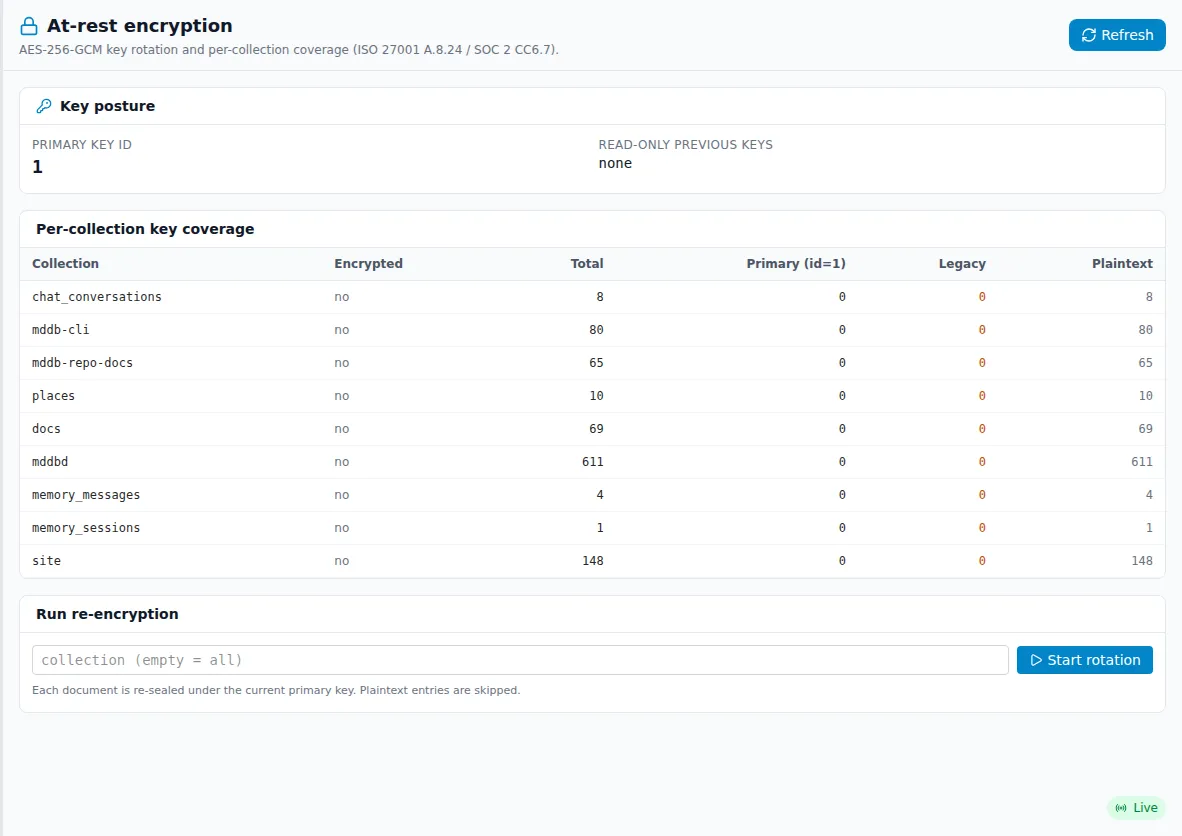
The admin panel exposes the same workflow under Sidebar → Encryption: keyID, per-collection coverage, "Start rotation" button, and a job table.
Audit Log Export (ISO 27001 / SOC 2) #
The audit log persists locally to BoltDB by default. For tamper-evident, off-host retention (the auditor expectation), mirror events to an external SIEM webhook or a syslog collector. Local BoltDB remains the source of truth — exporters are best-effort.
| Env Var | Default | Type | Description |
|---|---|---|---|
MDDB_AUDIT_EXPORT_WEBHOOK_URL |
(unset) | URL | Each audit event is POSTed as JSON to this URL with _mddb_event_type:audit decoration. Empty = exporter disabled. |
MDDB_AUDIT_EXPORT_WEBHOOK_HEADER |
(unset) | comma-separated list | Headers added to every request: Authorization: Splunk xxx,X-Source: prod. |
MDDB_AUDIT_EXPORT_WEBHOOK_INSECURE_TLS |
false |
bool | Skip TLS cert verification — only for self-signed development collectors. |
MDDB_AUDIT_EXPORT_SYSLOG_ADDR |
(unset) | host:port or proto://host:port | Syslog target. UDP by default; prefix tcp:// for TCP. |
MDDB_AUDIT_EXPORT_SYSLOG_FACILITY |
local0 |
facility name | RFC 5424 facility (local0–local7, daemon, auth, authpriv, ...). |
MDDB_AUDIT_EXPORT_BUFFER |
1024 |
integer | Bounded channel size per exporter. When full, oldest events are dropped (counted as dropped). |
Both sinks can run together; per-sink delivery counters are exposed at GET /v1/audit/exporters and rendered in the Security panel.
Quick recipe — Splunk HEC + papertrail-style syslog:
export MDDB_AUDIT_ENABLED=true
export MDDB_AUDIT_EXPORT_WEBHOOK_URL="https://splunk.example/services/collector/raw"
export MDDB_AUDIT_EXPORT_WEBHOOK_HEADER="Authorization: Splunk $HEC_TOKEN"
export MDDB_AUDIT_EXPORT_SYSLOG_ADDR="tcp://logs.papertrailapp.com:12345"
Backup Path Jail #
/v1/backup and /v1/restore accept a user-supplied path. Without bounds an admin (or an attacker who steals admin creds) could read or overwrite arbitrary files. The jail confines every backup to a single directory.
| Env Var | Default | Type | Description |
|---|---|---|---|
MDDB_BACKUP_DIR |
./backups |
path | Directory backups are written to and restored from. Symlinks that escape the jail are rejected; absolute paths and ../ traversal are rejected; empty / NUL bytes are rejected; a target that exists and is not a regular file (the directory itself, a subdirectory) is rejected. Paths are checked and backups written through os.Root, so a symlink created after the check cannot lead out of the directory |
MDDB_GEO_DATA_DIR |
"geodata" |
path | Directory postcode CSVs must live in. /v1/geo-reindex and its gRPC twin accept a name relative to it and refuse anything that resolves outside, symlinks included — the path used to be taken from the request and opened as given |
No further configuration required — the jail is always on.
Production Hardening (ISO 27001 / SOC 2) #
MDDB_PRODUCTION=true is a single switch that fails the server start unless every ISO 27001 / SOC 2 guardrail is satisfied. When unset, the guard logs a one-line warning at boot and continues with the same defaults as before — so existing deployments are unaffected.
| Env Var | Required when MDDB_PRODUCTION=true |
Reason |
|---|---|---|
MDDB_AUTH_ENABLED |
true |
A.5.15 / CC6.1 — access control |
MDDB_AUTH_JWT_SECRET |
≥32 bytes | A.8.24 / CC6.7 — key strength |
MDDB_TLS_ENABLED |
true (or MDDB_TLS_INSECURE_OK=true as an explicit opt-out for dev) |
A.8.24 / CC6.7 — encryption in transit |
MDDB_CORS_ORIGIN |
explicit origin list (not *) |
A.8.23 / CC6.6 — web-origin segmentation |
MDDB_AUDIT_ENABLED |
true |
A.8.15 / CC7.2 — audit trail |
MDDB_RATE_LIMIT_ENABLED |
true |
A.5.30 / CC6.6 — resource-exhaustion protection |
MDDB_TRUSTED_PROXIES |
the proxies' addresses — not 0.0.0.0/0 or ::/0 (unset is fine) |
A.8.15 / CC7.2 — an audit IP the client cannot choose |
On a successful production start the server logs:
✓ Production guards satisfied (ISO 27001 / SOC 2)
When a requirement is missing, startup is aborted with a line-by-line breakdown pointing at each offending env var.
Rate Limiting (HTTP + gRPC) #
Shared sliding-window limiter covering both HTTP and gRPC. Separate from the pre-existing MDDB_MCP_RATE_LIMIT_* budget, which continues to apply to the MCP endpoints only.
| Env Var | Default | Type | Description |
|---|---|---|---|
MDDB_RATE_LIMIT_ENABLED |
false |
bool | Enable the limiter. When off, both HTTP and gRPC are passthrough. |
MDDB_RATE_LIMIT_REQUESTS |
100 |
int | Sustained requests per window. |
MDDB_RATE_LIMIT_WINDOW |
60 |
int seconds | Window length. |
MDDB_RATE_LIMIT_BURST |
50 |
int | Additional allowance before a client is blocked. Effective ceiling = REQUESTS + BURST. |
MDDB_RATE_LIMIT_BY |
"ip" |
string | "ip" (default) or "user". user keys on the authenticated username and falls back to IP for anonymous traffic. |
MDDB_TRUSTED_PROXIES |
"" |
list | Comma-separated IPs or CIDR prefixes of the reverse proxies and load balancers whose client IP header and PROXY header are believed, e.g. 127.0.0.1,10.0.0.0/8,fd00::/8. Empty (the default) trusts nobody. An entry that is not an IP or prefix stops startup with that entry named. 0.0.0.0/0 or ::/0 trusts every client again: mddbd warns at startup and MDDB_PRODUCTION=true refuses it. See Client IP and trusted proxies. |
MDDB_CLIENT_IP_HEADER |
X-Forwarded-For |
string | The header a trusted proxy puts the client address in. X-Forwarded-For (with the X-Real-IP fallback) and Forwarded (RFC 7239) are chains; any other name (X-Real-IP, CF-Connecting-IP, True-Client-IP, X-Cluster-Client-Ip, Client-IP, ...) is one address. gRPC reads the same name in lower case from the metadata. A name that is not a valid HTTP header name stops startup. See Proxies and load balancers. |
MDDB_PROXY_PROTOCOL |
off |
off/on |
PROXY protocol v1 and v2 on the HTTP, gRPC and MCP listeners. When on, a peer in MDDB_TRUSTED_PROXIES must send a PROXY header and any other peer must not. Any other value stops startup. See PROXY protocol. |
GET /v1/config reports these settings under clientAddressing: how many trusted proxy entries there are (never their addresses), the client IP header and whether PROXY protocol is on. The admin panel shows them on the Config and System pages.
HTTP responses carry X-RateLimit-Limit, X-RateLimit-Remaining, X-RateLimit-Reset; rejected requests get 429 Too Many Requests with Retry-After. gRPC rejects with codes.ResourceExhausted. The paths /health, /v1/health, and /metrics are always exempt so monitoring and load-balancer probes never trip the limiter.
Client IP and trusted proxies #
One rule decides the client IP for the HTTP and gRPC rate limiters, the MCP rate limiter and access log, the HTTP access log (client field), the SSE per-IP connection cap, and the audit log (login attempts, writes, incident detection):
- If the connecting peer (
RemoteAddr, or the gRPC peer address) is not inMDDB_TRUSTED_PROXIES, the peer is the client. Every client IP header is ignored, so a client cannot pick its own rate-limit bucket or audit IP. - If the peer is a trusted proxy, the header named by
MDDB_CLIENT_IP_HEADERis read (gRPC: the same name in lower case in the metadata):X-Forwarded-For(the default) is read right to left, skipping trusted proxies; the first other address is the client. All header lines are joined in order, so a proxy that adds a line (HAProxy) and one that appends to the line (nginx) work the same. A hop that is not an IP address ends the walk. If that finds nothing,X-Real-IPis used when it is an IP address.Forwarded(RFC 7239) is walked the same way over thefor=parameter of each element:for=192.0.2.60,for="[2001:db8:cafe::17]:4711",for="198.51.100.4:_port". An element withfor=unknown, an obfuscated node (for=_hidden) or nofor=ends the walk.X-Real-IPis not consulted.- Any other name (
X-Real-IP,CF-Connecting-IP,True-Client-IP,X-Cluster-Client-Ip,Client-IP, ...) holds one address set by the nearest proxy. The last line of that header is used; it must be one IP address (a port is dropped). A list or anything else is ignored.
- If the header yields nothing, the peer is the client.
Addresses are canonical: the port is dropped, IPv6 is lower-case and compressed, and IPv4-mapped IPv6 (::ffff:1.2.3.4) becomes 1.2.3.4. A Unix-socket peer keeps its socket name.
Behind a reverse proxy, list the proxy's address, or else every client looks like the proxy and shares one bucket:
export MDDB_TRUSTED_PROXIES=127.0.0.1,172.16.0.0/12   # the proxy on the host or the Docker network
export MDDB_CLIENT_IP_HEADER=X-Forwarded-For          # the default; see the table below for your proxy
The first time a client IP header arrives from a peer that is not trusted, mddbd logs one warning naming that peer and the header — the sign that MDDB_TRUSTED_PROXIES is missing. 0.0.0.0/0 or ::/0 in MDDB_TRUSTED_PROXIES makes every client a trusted proxy, which undoes all of the above: mddbd logs a warning at startup, and MDDB_PRODUCTION=true refuses to start.
PROXY protocol #
Layer-4 load balancers (HAProxy, AWS NLB, nginx stream, Traefik TCP routers) cannot add an HTTP header; they put the client address in a PROXY protocol header in front of the connection instead. MDDB_PROXY_PROTOCOL=on reads it, v1 (text) and v2 (binary), on the HTTP API, gRPC and MCP listeners. The header is read below TLS, so it works with MDDB_TLS_ENABLED=true and with gRPC TLS. After the header, the connection's peer address is the client it names, and the rule above applies to it: when that address is itself a trusted proxy, the client IP header is read as well.
Who may send a header:
| Connecting peer | Sends a PROXY header | Sends none |
|---|---|---|
In MDDB_TRUSTED_PROXIES |
Accepted. A LOCAL header (a load balancer's health check) keeps the peer's own address. |
Refused — the connection is closed. A load balancer that stops sending the header is misconfigured, and guessing would put every client behind it in one bucket. |
Not in MDDB_TRUSTED_PROXIES |
Refused — a client cannot choose its own address. | Served, as itself. Direct clients and local health checks keep working. |
A peer has 10 seconds to send its header (like ReadHeaderTimeout). The header is read in the connection's own goroutine, never in the accept loop, so a slow peer holds only its own connection. With the switch on and MDDB_TRUSTED_PROXIES empty, every header is refused and mddbd warns at startup.
Not covered: HTTP/3 (QUIC is UDP; no PROXY protocol), the Unix-socket listeners (their peers have no IP, so they are never trusted), and the short-lived /health listener that answers while the server starts — a load balancer that sends PROXY headers sees it as unhealthy until the server is up, which is what it is.
Health checks. With
MDDB_PROXY_PROTOCOL=on, a container health check that connects from an address inMDDB_TRUSTED_PROXIES(for examplewget http://localhost:11023/healthwith127.0.0.1trusted) is refused, because it sends no header. Keep the health check's source out of the trusted list: the load balancer's address or subnet, not127.0.0.1or the whole Docker network.
Proxies and load balancers #
What each product sends by default and what to set in mddb. Every row was checked against the vendor documentation listed under it (October 2026); what the documentation does not say is marked not verified.
| Product | Sends by default | Set in mddb | Proxy side (minimal) |
|---|---|---|---|
| nginx (HTTP)[1] | Nothing: only Host and Connection are set; a client's own X-Forwarded-For passes through. |
MDDB_TRUSTED_PROXIES=<nginx address> |
proxy_set_header X-Forwarded-For $proxy_add_x_forwarded_for; (appends $remote_addr). Or proxy_set_header X-Real-IP $remote_addr; with MDDB_CLIENT_IP_HEADER=X-Real-IP. |
nginx (stream)[2] |
No PROXY header. | MDDB_PROXY_PROTOCOL=on, MDDB_TRUSTED_PROXIES=<nginx address> |
proxy_protocol on; sends v1; proxy_protocol v2; sends v2 (newer nginx, see the module docs for the version). |
| Traefik[3][4] | HTTP: appends the peer to X-Forwarded-For; incoming X-Forwarded-* are believed only from entryPoints.<ep>.forwardedHeaders.trustedIPs. |
MDDB_TRUSTED_PROXIES=<Traefik address> |
Nothing for HTTP. TCP routers: serversTransport proxyProtocol: { version: 2 } (version 1 or 2; 2 is the default) plus MDDB_PROXY_PROTOCOL=on. PROXY to backends from HTTP routers: not verified. |
| Caddy[5] | reverse_proxy sets or augments X-Forwarded-For; incoming values are ignored unless the peer is in Caddy's trusted_proxies. |
MDDB_TRUSTED_PROXIES=<Caddy address> |
Nothing for the header. PROXY: reverse_proxy mddb:11023 { transport http { proxy_protocol v2 } } plus MDDB_PROXY_PROTOCOL=on. |
| HAProxy[6] | Nothing. | MDDB_TRUSTED_PROXIES=<HAProxy address> |
option forwardfor (adds an X-Forwarded-For line at the end; mddb joins all lines). PROXY: server mddb 10.0.0.10:11023 send-proxy-v2 (send-proxy for v1) plus MDDB_PROXY_PROTOCOL=on. |
| F5 BIG-IP[7][8] | Nothing: the HTTP profile's Insert X-Forwarded-For defaults to Disabled. Whether it appends to a client's header: not verified. | MDDB_TRUSTED_PROXIES=<self IPs / SNAT pool> |
HTTP profile: Insert X-Forwarded-For = Enabled. PROXY: no native setting found (not verified); the DevCentral CodeShare "Proxy Protocol Initiator" iRule (community code, v1) sends PROXY TCP4 ... on SERVER_CONNECTED, plus MDDB_PROXY_PROTOCOL=on. |
| Citrix NetScaler ADC[9][10][11] | Nothing until Client IP insertion is enabled on the service. The header name is the admin's; with none given (and no global one) it is client-ip. Append vs replace: not verified. |
MDDB_CLIENT_IP_HEADER=<the name chosen> (e.g. Client-IP), MDDB_TRUSTED_PROXIES=<SNIP> |
set service svc_mddb -CIP ENABLED Client-IP. PROXY: add netprofile np_mddb -proxyProtocol ENABLED -proxyprotocoltxversion V2, set service svc_mddb -netProfile np_mddb, plus MDDB_PROXY_PROTOCOL=on. |
| Ivanti / Pulse / Brocade vTM[12][13] | X-Cluster-Client-Ip with the client IP (virtual server add_cluster_ip, default Yes). add_x_forwarded_for defaults to No. Whether a client's own X-Cluster-Client-Ip is replaced: not verified. |
MDDB_CLIENT_IP_HEADER=X-Cluster-Client-Ip, MDDB_TRUSTED_PROXIES=<vTM addresses> |
Nothing (default). vTM's proxy_protocol setting only accepts PROXY headers from clients; sending one to a pool is left to TrafficScript, with no documented function: not verified — use the header. |
| Cloudflare (proxied DNS)[14][15][16] | CF-Connecting-IP (one address); X-Forwarded-For appended; True-Client-IP only with the Enterprise managed transform. |
MDDB_CLIENT_IP_HEADER=CF-Connecting-IP, MDDB_TRUSTED_PROXIES=<Cloudflare's published ranges> |
Nothing. |
| cloudflared (Cloudflare Tunnel)[14][17] | The origin's peer is the cloudflared process; for HTTP the client is in CF-Connecting-IP. Non-HTTP (TCP) tunnels carry no client IP. |
MDDB_CLIENT_IP_HEADER=CF-Connecting-IP, MDDB_TRUSTED_PROXIES=<cloudflared's address>: 127.0.0.1 on the same host, or the Docker network (e.g. 172.16.0.0/12) when cloudflared runs in a container. |
Nothing. |
| AWS ALB[18] | X-Forwarded-For appended (routing.http.xff_header_processing.mode=append, the default; preserve and remove exist). With routing.http.xff_client_port.enabled the entry is ip:port / [ipv6]:port; mddb drops the port. |
MDDB_TRUSTED_PROXIES=<the ALB's subnet CIDRs> |
Nothing (default). |
| AWS NLB[19] | Client IP preservation (preserve_client_ip.enabled) is on by default for instance targets, off for IP targets with TCP/TLS; with it on, the peer already is the client. |
Preservation on: nothing. Otherwise MDDB_PROXY_PROTOCOL=on, MDDB_TRUSTED_PROXIES=<the NLB's subnet CIDRs> |
Target group attribute proxy_protocol_v2.enabled=true (v2 only). Health checks carry a header without client data too; mddb accepts it. |
Sources:
- nginx
ngx_http_proxy_module— https://nginx.org/en/docs/http/ngx_http_proxy_module.html - nginx
ngx_stream_proxy_module— https://nginx.org/en/docs/stream/ngx_stream_proxy_module.html - Traefik entry points (
forwardedHeaders) — https://doc.traefik.io/traefik/reference/install-configuration/entrypoints/ - Traefik TCP serversTransport (
proxyProtocol) — https://doc.traefik.io/traefik/reference/routing-configuration/tcp/serverstransport/ - Caddy
reverse_proxy— https://caddyserver.com/docs/caddyfile/directives/reverse_proxy - HAProxy 3.2 configuration manual (
option forwardfor,send-proxy,send-proxy-v2) — https://www.haproxy.org/download/3.2/doc/configuration.txt - F5 BIG-IP LTM profiles reference (HTTP profile) — https://techdocs.f5.com/kb/en-us/products/big-ip_ltm/manuals/product/ltm-profiles-reference-13-0-0/2.html
- F5 DevCentral CodeShare, Proxy Protocol Initiator (community) — https://community.f5.com/kb/codeshare/proxy-protocol-initiator/280541
- NetScaler, insert the client IP in the request header — https://docs.netscaler.com/us/en/citrix-adc/current-release/load-balancing/load-balancing-advanced-settings/insert-cip-in-request-hdr.html
- NetScaler command reference,
service— https://developer-docs.netscaler.com/en-us/adc-command-reference-int/current-release/basic/service - NetScaler PROXY protocol — https://docs.netscaler.com/en-us/citrix-adc/current-release/system/proxy-protocol.html
- Ivanti vTM 22.x virtual server configuration keys — https://help.ivanti.com/ps/help/en_US/VTM/22.x/config/ps-vtm-config/conf_vservers.htm
- Ivanti vTM 22.x PROXY protocol — https://help.ivanti.com/ps/help/en_US/VTM/22.x/userguide/ps-vtm-userguide/proxy_protocol.htm
- Cloudflare HTTP request headers — https://developers.cloudflare.com/fundamentals/reference/http-headers/
- Cloudflare managed transforms (
True-Client-IP) — https://developers.cloudflare.com/rules/transform/managed-transforms/reference/ - Cloudflare IP ranges — https://www.cloudflare.com/ips/
- Cloudflare One connectivity options (what the origin sees behind
cloudflared) — https://developers.cloudflare.com/cloudflare-one/networks/connectivity-options/ - AWS ALB
X-Forwardedheaders — https://docs.aws.amazon.com/elasticloadbalancing/latest/application/x-forwarded-headers.html - AWS NLB target group attributes — https://docs.aws.amazon.com/elasticloadbalancing/latest/network/edit-target-group-attributes.html
Audit Log (ISO 27001 / SOC 2) #
Structured authentication and mutation trail persisted to a dedicated audit BoltDB bucket. Events are buffered and flushed asynchronously so hot-path handlers never block on disk I/O. Queryable via admin-only GET /v1/audit.
| Env Var | Default | Type | Description |
|---|---|---|---|
MDDB_AUDIT_ENABLED |
false |
bool | Enable the audit log. When disabled, AuditManager is a no-op and /v1/audit returns 404. |
MDDB_AUDIT_RETENTION_DAYS |
90 |
int | Retention window. A background trimmer runs every hour and deletes events older than the cutoff. |
Query parameters on GET /v1/audit: from / to (RFC3339) or fromNanos / toNanos, actor, action, result (ok/fail), limit (default 100). Response shape: {events: [...], count, dropped} — dropped counts events lost when the in-memory buffer was full.
Embedding / Vector Search #
| Env Var | Default | Type | Description |
|---|---|---|---|
MDDB_EMBEDDING_PROVIDER |
"" (disabled) |
string | Provider: "openai", "ollama", "voyage", "cohere", "lexical" (hashed words and n-grams, no model, no network, does not match by meaning — see EMBEDDING_PROVIDERS; never autodetected), or "". When empty and nothing is stored, MDDB probes a local Ollama once at startup — see MDDB_EMBEDDING_AUTODETECT |
MDDB_UPDATE_CHECK |
"1" |
bool | Set to 0 to skip the startup release check. One GET to a pinned GitHub URL, carrying nothing about this installation; the answer is cached in /health |
MDDB_EMBEDDING_AUTODETECT |
"1" |
bool | Set to 0 (or false, no, off) to skip the startup probe for a local Ollama. The probe is one GET localhost:11434/api/tags with a two-second budget, and only runs when no provider is configured |
OLLAMA_HOST |
http://localhost:11434 |
string | Where the autodetection probe looks. Accepted with or without a scheme |
MDDB_EMBEDDING_API_KEY |
"" |
string | API key (for openai/voyage/cohere) |
MDDB_EMBEDDING_API_URL |
(see below) | string | API base URL |
MDDB_EMBEDDING_MODEL |
(see below) | string | Embedding model name |
MDDB_EMBEDDING_DIMENSIONS |
(see below) | int | Vector dimensionality |
MDDB_EMBEDDING_IMAGE_MODEL |
"" |
string | Voyage: the multimodal model pictures are embedded with (default voyage-multimodal-3.5, or the text model itself when it is multimodal). none embeds no pictures, with Voyage or Cohere. Other providers embed no images. See EMBEDDING_PROVIDERS |
MDDB_EMBEDDING_CHUNK_ENABLED |
true |
bool | Enable text chunking before embedding |
MDDB_EMBEDDING_CHUNK_MODE |
"" |
string | code or prose for every document; empty decides per document. A collection's embedding.chunkMode takes precedence |
MDDB_EMBEDDING_CHUNK_SIZE |
1500 |
int | Maximum chunk size in characters. A collection can set its own with embedding.chunkSize in its collection config |
MDDB_EMBEDDING_QUEUE_SIZE |
1000 |
int | Pending embedding jobs the worker will hold — per tenant since v2.19.8 (collections outside any namespace share one queue), and the workers take one tenant's job after another's. Raise it for large imports; it was hardcoded before |
MDDB_EMBEDDING_QUEUE_WAIT |
5s |
duration | How long a write waits for room in its tenant's full queue. Since v2.19.8 a job that found no room is parked — it stays pending in /v1/indexing-status and goes back on the queue as soon as there is room — instead of being dropped. 0 parks at once |
MDDB_EMBEDDING_PARK_MAX |
100000 |
int | (v2.19.8+) Jobs the worker keeps parked — waiting for room in the queue or for an embedding budget — over all tenants. Past it a job is dropped as before: stored without its vector, counted in /v1/vector-stats queue.dropped and mddb_operations_total{operation="embedding",label="dropped"}. 0 restores the drop-when-full behaviour of 2.15–2.19.7 |
MDDB_EMBEDDING_CACHE_SIZE |
1024 |
int | Embeddings held in the query cache; 0 disables caching |
MDDB_EMBEDDING_CACHE_TTL |
3600 |
int | Cache entry lifetime in seconds |
Model reranking (v2.19.8+, RAG-011) #
An optional reranking model orders a search's best candidates after
retrieval — see SEARCH. Nothing here is
set by default, and with nothing set no search changes. A stored rerank
configuration (POST /v1/embedding-configs with "kind": "rerank", made the
default with POST /v1/embedding-configs/set-default) overrides these
variables, as a stored embedding configuration does.
| Env Var | Default | Type | Description |
|---|---|---|---|
MDDB_RERANK_PROVIDER |
"" (off) |
string | http turns the stage on; "" or none leaves it off. Any other value is logged and ignored |
MDDB_RERANK_API_URL |
"" |
string | Base URL of the model server; MDDB posts to {url}/rerank. Required. Validated like an embedding provider's URL: loopback needs no opt-in, any other private or reserved address needs MDDB_OUTBOUND_ALLOW_PRIVATE or MDDB_OUTBOUND_ALLOWLIST |
MDDB_RERANK_API_KEY |
"" |
string | Sent as Authorization: Bearer <key> when set. Never logged and never returned by the API |
MDDB_RERANK_MODEL |
"" |
string | Sent as model in each request and reported in responses |
MDDB_RERANK_TIMEOUT_MS |
2000 |
int | Limit on one model call. A call that runs over leaves the search's own order in place with rerankSkipped: "timeout" |
MDDB_RERANK_MAX_CANDIDATES |
50 |
int | Most results one search sends to the model, and the default candidates; capped at 200 and at the server's result cap |
MDDB_RERANK_CACHE_SIZE |
4096 |
int | (query, passage) scores remembered, one hour each; 0 turns the cache off |
The request shape, as a fact about the code: POST {url}/rerank with
{"model", "query", "documents": [...], "top_n"}, answered with a list of
{"index", "relevance_score"} (or "score") under results, under data,
or as the whole body. Each call counts one call and its estimated tokens
against the collection's daily embedding budget (quota.embeddingCallsPerDay,
quota.embeddingTokensPerDay).
Provider Defaults #
| Provider | API_URL |
MODEL |
DIMENSIONS |
|---|---|---|---|
openai |
https://api.openai.com/v1 |
text-embedding-3-small |
1536 |
ollama |
http://localhost:11434 |
nomic-embed-text |
768 |
voyage |
https://api.voyageai.com/v1 |
voyage-3 |
1024 |
cohere |
https://api.cohere.ai/v1 |
embed-english-v3.0 |
1024 |
lexical |
— (no network) | lexical-ngram-v1 (fixed) |
512, clamped to 256–2048 |
GET /config reports vectorConfig.semantic: true for every model-backed
provider, false for lexical, whose vectors match shared spelling rather
than meaning. The search advisor (/v1/search-advisor) reports the same in
profile.semantic and recommends keyword search for lexical collections
unless the collection's own evaluation set measures hybrid better. The gRPC
SearchAdvisor carries it as CollectionProfile.semantic (15,
optional bool), unset when nothing in the collection is embedded.
Vector Index #
| Env Var | Default | Type | Description |
|---|---|---|---|
MDDB_VECTOR_DEFAULT_ALGORITHM |
"flat" |
string | Default algorithm: "flat", "hnsw", "ivf", "pq", "opq", "sq", "bq" |
MDDB_VECTOR_BQ_RERANK_FACTOR |
10 |
int | Binary quantization rerank factor |
MDDB_VECTOR_PARALLEL_WORKERS |
NumCPU (max 16) |
int | Number of goroutines for parallel vector scoring |
MDDB_VECTOR_PARALLEL_MIN_SIZE |
2048 |
int | Minimum collection size to enable parallel search |
MDDB_VECTOR_INDEX_PERSIST |
true |
bool | v2.19.8+: keep each collection's built HNSW graph and IVF / PQ / OPQ / SQ / SQ4 structures in a checkpoint file and read it back at start instead of rebuilding and retraining; anything that cannot be verified is rebuilt as before. false = the behaviour before v2.19.8: nothing read, nothing written. See SEARCH |
MDDB_VECTOR_INDEX_CHECKPOINT_INTERVAL_SEC |
300 |
int | v2.19.8+: longest time a collection whose indexes changed waits for its next checkpoint (minimum 1) |
MDDB_VECTOR_INDEX_CHECKPOINT_CHANGES |
50000 |
int | v2.19.8+: vector writes that bring a collection's checkpoint forward, if the last one is at least 10 s and twenty times its own duration old (minimum 1) |
MCP Server Info #
Customize the MCP server profile returned in the initialize response. Useful for identifying your server to LLM clients.
| Env Var | Default | Type | Description |
|---|---|---|---|
MDDB_MCP_SERVER_NAME |
"mddbd" |
string | Server name shown to MCP clients |
MDDB_MCP_SERVER_DESCRIPTION |
"" |
string | Human-readable server description |
MDDB_MCP_SERVER_VENDOR |
"" |
string | Organization / vendor name |
MDDB_MCP_SERVER_HOMEPAGE |
"" |
string | URL to server documentation or homepage |
MDDB_MCP_INSTRUCTIONS |
"" |
string | System prompt for LLM — tells the AI how to use this server. Unset, a server that holds code sends a short default naming the code tools (code_symbol with format: "lines", code_search) to a key bound to no chat scenario that may use the code toolset; none turns the default off (v2.19.13) |
MDDB_MCP_INSTRUCTIONS_FILE |
"" |
string | Path to a file with the instructions, read at startup; MDDB_MCP_INSTRUCTIONS wins when both are set |
Or via YAML config:
mcp:
  serverInfo:
    name: "my-knowledge-base"
    description: "Company internal documentation"
    vendor: "Acme Corp"
    homepage: "https://docs.acme.com"
  instructions: |
    This is the company knowledge base. Use search_documents to find
    relevant articles before answering questions. Always cite document
    keys in your responses. Prefer the 'docs' collection for technical
    questions and 'blog' for product updates.
Server-Sent Events (SSE) #
| Env Var | Default | Type | Description |
|---|---|---|---|
MDDB_SSE_ENABLED |
true |
bool | Enable SSE event stream at /v1/events |
MDDB_SSE_MAX_CLIENTS |
1000 |
int | Maximum total concurrent SSE connections |
MDDB_SSE_MAX_PER_IP |
5 |
int | Maximum concurrent SSE connections per IP address |
TLS / HTTPS / mTLS #
See TLS for the full setup guide (cert generation, recipes, troubleshooting).
| Env Var | Default | Type | Description |
|---|---|---|---|
MDDB_TLS_ENABLED |
false |
bool | Enable built-in TLS (HTTPS) on the HTTP listener |
MDDB_TLS_CERT |
"" |
string | Path to server TLS certificate (PEM) |
MDDB_TLS_KEY |
"" |
string | Path to server TLS private key (PEM) |
MDDB_TLS_CLIENT_CA |
"" |
string | Path to PEM bundle of trusted client CAs — enables mTLS when set |
MDDB_TLS_CLIENT_AUTH |
"require" |
string | mTLS mode when MDDB_TLS_CLIENT_CA is set: require (reject anonymous clients) or request (verify only if cert presented) |
MinVersion is pinned to TLS 1.2. mTLS is automatically skipped on UDS listeners (filesystem permissions already authenticate the local peer).
Unix Domain Socket transport #
MDDB_HTTP_ADDR and MDDB_GRPC_ADDR accept either a TCP host:port (default) or a Unix Domain Socket address of the form unix:/absolute/path.sock. The server creates the socket with owner-only 0600 permissions, removes any stale socket file from a previous run, and unlinks the socket on graceful shutdown.
# HTTP API on a UDS, gRPC on TCP, no public HTTP port
MDDB_HTTP_ADDR=unix:/var/run/mddb/http.sock \
MDDB_GRPC_ADDR=:11024 \
./mddbd
TLS is automatically disabled on UDS listeners (peer is authenticated by filesystem permissions; API keys / JWT still apply on top). Per-IP rate limits in SSE collapse to a single bucket on UDS — apply application-level rate limiting if you need to differentiate clients.
Not available on Windows. The security model above rests on the 0600 mode bits, and Windows cannot express them: os.Chmod there toggles the read-only attribute and nothing more. Windows 10 does support AF_UNIX, so the socket would bind and serve — with the access restriction silently absent. MDDB refuses the listener instead and says why. Use tcp://127.0.0.1:<port> on Windows.
Clients with native UDS support:
| Client | Address form |
|---|---|
Python (services/python-extension/mddb.py) |
MDDB.connect('unix:/var/run/mddb/http.sock') |
PHP (services/php-extension/mddb.php) |
mddb::connect('unix:/var/run/mddb/http.sock') |
Python gRPC (clients/python/) |
grpc.insecure_channel('unix:/var/run/mddb/grpc.sock') |
Node gRPC (clients/nodejs/) |
new MDDBClient('unix:/var/run/mddb/grpc.sock', creds) |
curl |
curl --unix-socket /var/run/mddb/http.sock http://localhost/v1/healthz |
Logging #
The operational log is structured. text is the readable default for a
terminal; json emits one object per line — time (RFC 3339), level, msg
and the event's own fields — which is what a collector wants, so the container
image sets it. Severity lives in the level field, never in the message, so
level=error is a filter rather than a regular expression over prose.
This is separate from the audit trail, which has its own retention,
RFC 5424 syslog export and SIEM webhooks — see
SECURITY and the MDDB_AUDIT_* variables.
| Env Var | Default | Type | Description |
|---|---|---|---|
MDDB_LOG_FORMAT |
text (json in the Docker image) |
string | Output encoding: text or json |
MDDB_LOG_LEVEL |
info |
string | Minimum level emitted: debug, info, warn, error |
MDDB_ACCESS_LOG |
false |
bool | One line per HTTP request: method, path, status, bytes, elapsed, remote address (the transport peer) and client (the address resolved by the trusted-proxy rule below; differs from remote behind a proxy). The query string is deliberately omitted — search endpoints carry user content there |
Access log lines take their level from the status: 5xx is error, 4xx is
warn, everything else info.
{"time":"2026-08-21T14:03:11.412Z","level":"ERROR","msg":"embedding failed after all attempts","collection":"docs","docID":"intro","chunk":2,"err":"context deadline exceeded"}
Profiling #
| Env Var | Default | Type | Description |
|---|---|---|---|
MDDB_PPROF_ENABLED |
false |
bool | Enable pprof profiling endpoints at /debug/pprof/ |
HTTP Connection Pool #
| Env Var | Default | Type | Description |
|---|---|---|---|
MDDB_HTTP_POOL_MAX_IDLE |
100 |
int | Max idle connections in shared HTTP pool |
MDDB_HTTP_POOL_MAX_PER_HOST |
10 |
int | Max idle connections per target host |
MDDB_HTTP_POOL_IDLE_TIMEOUT |
90 |
int | Idle connection timeout in seconds |
Full-Text Search (FTS) #
| Env Var | Default | Type | Description |
|---|---|---|---|
MDDB_FTS_STEMMING |
true |
bool | Enable Porter stemming for FTS indexing and queries |
MDDB_FTS_SYNONYMS |
true |
bool | Enable synonym expansion in FTS queries |
MDDB_FTS_DEFAULT_LANG |
"en" |
string | Default language for stemming and stop words |
MDDB_CODE_MAX_SYMBOLS |
512 |
int | Most defines, uses and imports entries kept per code document (API) |
MDDB_CODE_MAX_FACTS |
4096 |
int | Most semantic-fact values (symDefs, symImpls, symRefs together) kept per code document; over it, symIndex gains truncated (API) |
Temporal Tracking #
| Env Var | Default | Type | Description |
|---|---|---|---|
MDDB_TEMPORAL |
false |
bool | Enable document lifecycle event tracking (create/update/access) |
When enabled, provides endpoints: POST /v1/temporal/query, POST /v1/temporal/hot, POST /v1/temporal/histogram. Per-collection opt-in via Collection Settings (trackAccess, trackHot).
Spell Correction #
| Env Var | Default | Type | Description |
|---|---|---|---|
MDDB_SPELL |
false |
bool | Enable SymSpell-style spell checker for FTS queries |
When enabled, provides endpoints: POST /v1/spell-suggest, POST /v1/spell-cleanup, GET/PUT/DELETE /v1/spell-dictionary. Enable spellCorrect: true on a collection for auto-correction.
Compression #
| Env Var | Default | Type | Description |
|---|---|---|---|
MDDB_COMPRESSION_ENABLED |
true |
bool | Enable adaptive compression of stored documents and revisions (not indexes, vectors or API traffic) |
MDDB_COMPRESSION_SMALL_THRESHOLD |
1024 |
int (bytes) | Below this: stored uncompressed. From here up to the medium threshold: Snappy |
MDDB_COMPRESSION_MEDIUM_THRESHOLD |
10240 |
int (bytes) | From this size: Zstd (default level). Either codec is kept only when the result is smaller |
Replication #
| Env Var | Default | Type | Description |
|---|---|---|---|
MDDB_REPLICATION_ROLE |
"" |
string | Role: "leader", "follower", or "" (standalone) |
MDDB_NODE_ID |
"" |
string | Unique node ID (required for replication) |
MDDB_REPLICATION_LEADER_ADDR |
"" |
string | Leader address for follower nodes |
MDDB_BINLOG_ENABLED |
false |
bool | Enable binary log (auto-enabled for leaders). A follower always keeps its copy of the leader's log at the binlog path and opens no log of its own (v2.19.8+) |
MDDB_BINLOG_PATH |
"" |
string | Custom binlog file path (default: mddb.binlog next to the database). Its sidecar is <path>.meta |
MDDB_BINLOG_SYNC |
interval |
string | When an entry reaches the disk: interval syncs in the background about every 100 ms; commit syncs before the write returns. A leader stopped uncleanly in either mode starts a new log and its followers resynchronise from a snapshot (REPLICATION, v2.19.8+) |
MDDB_BINLOG_MAX_SIZE |
268435456 |
int (bytes) | Size at which retention drops the oldest entries, down to half of it — except entries a known follower has not confirmed (v2.19.8+) |
MDDB_BINLOG_HARD_MAX_SIZE |
4 × max size | int (bytes) | Size past which even unconfirmed entries are dropped; a follower behind them takes a snapshot (v2.19.8+) |
MDDB_BINLOG_MAX_AGE |
24h |
duration | Age past which entries are dropped, except those a known follower has not confirmed; also how long a disconnected follower is remembered (v2.19.8+) |
MDDB_REPLICATION_TLS |
false |
bool | Follower: dial the leader over TLS. Implied by any of the MDDB_REPLICATION_TLS_* files (v2.19.8+) |
MDDB_REPLICATION_TLS_CA |
"" |
string | Follower: PEM CA bundle the leader's certificate is checked against (default: the system pool) |
MDDB_REPLICATION_TLS_CERT |
"" |
string | Follower: client certificate (PEM) for a leader that requires mTLS; set with MDDB_REPLICATION_TLS_KEY |
MDDB_REPLICATION_TLS_KEY |
"" |
string | Follower: the client certificate's key (PEM) |
MDDB_REPLICATION_TLS_SERVER_NAME |
"" |
string | Follower: the name the leader's certificate must carry, when it differs from the host in MDDB_REPLICATION_LEADER_ADDR |
MDDB_REPLICATION_SECRET |
"" |
string | Shared secret for the snapshot and binlog streams; the same value on the leader and every follower. Without it, auth or mTLS, a leader refuses them (REPLICATION) |
MDDB_CLUSTER_PEERS |
"" |
string | Every node of a cluster, this one included: id=host:grpcport,…. Turns on leader election; MDDB_REPLICATION_ROLE then only bootstraps (leader) (CLUSTER, v2.19.8+) |
MDDB_CLUSTER_ADVERTISE_HTTP |
"" |
string | This node's HTTP base URL, sent to clients whose write reached a node that does not lead (v2.19.8+) |
MDDB_CLUSTER_AUTO_FAILOVER |
true |
bool | Nodes stand for election on their own; forced off below three nodes, where a leader is made by promotion (v2.19.8+) |
MDDB_CLUSTER_BOOTSTRAP |
false |
bool | Lead a cluster that has never had a term at once (v2.19.8+) |
MDDB_CLUSTER_HEARTBEAT |
500ms |
duration | How often the leader reaches every node (v2.19.8+) |
MDDB_CLUSTER_ELECTION_TIMEOUT |
3s |
duration | Silence after which a node stands for election; each wait is drawn between it and twice it; at least twice the heartbeat. The leader's lease is three quarters of it (v2.19.8+) |
MDDB_CLUSTER_REJECTED_DIR |
"" |
string | Where a node that rejoins saves the writes the new leader never had (default: next to the binlog) (CLUSTER, v2.19.8+) |
MDDB_REPLICATION_ACK |
async |
string | async: a write returns once the leader committed it; quorum: once a majority of the cluster holds it. quorum needs MDDB_CLUSTER_PEERS (v2.19.8+) |
MDDB_REPLICATION_ACK_TIMEOUT |
5s |
duration | How long a quorum write waits for the majority before it fails (v2.19.8+) |
MDDB_PLACEMENT_GROUPS |
"" |
string | Places collections across groups of nodes: JSON {"meta":"<group>","groups":{"<group>":[{"id":"<MDDB_NODE_ID>","grpc":"host:port","http":"http(s)://host:port"},…],…}}, or @/path/to/file.json. The same value on every node; each group is a cluster whose MDDB_CLUSTER_PEERS lists exactly its nodes. Needs MDDB_STORAGE_LAYOUT=per-collection (CLUSTER, v2.19.8+) |
MDDB_PLACEMENT_ROUTE |
forward |
string | A request for a collection of another group: forward sends it to that group's leader and returns the answer; redirect answers 421 with X-MDDB-Leader and X-MDDB-Group (v2.19.8+) |
MDDB_PLACEMENT_REFRESH |
1s |
duration | How often a node fetches the placement map and runs its group's duties (pinning, copying global settings every 5 rounds, dropping moved collections) (v2.19.8+) |
MDDB_PLACEMENT_DROP_GRACE |
30s |
duration | How long the old group keeps a moved collection before it drops its copy (v2.19.8+) |
MDDB_PLACEMENT_FENCE_TIMEOUT |
10s |
duration | During a move's switch-over: how long routed writes to the collection are held, and how long the fence waits for running writes (v2.19.8+) |
MDDB_FREELIST_SYNC |
auto | bool | Write bbolt's freelist on every commit so opening the database reads one page instead of the whole file. On a 908 MB database: 7 ms and 37 MB RSS instead of ~400 ms and 938 MB; minutes from a cold disk on large files (DEPLOYMENT). A clean shutdown stores the freelist anyway; this setting is what protects a start after a crash. Unset (or auto): on for a file of MDDB_FREELIST_SYNC_THRESHOLD or more, decided at start; true/false force it |
MDDB_FREELIST_SYNC_THRESHOLD |
4294967296 |
int | File size in bytes from which MDDB_FREELIST_SYNC defaults to on |
MDDB_STATS_TTL |
300 |
int | Seconds between background recounts for /v1/stats on a database whose count is slow |
MDDB_STATS_WAIT |
2 |
int | Seconds the first /v1/stats after a start waits for the count before answering statsPending |
MDDB_STORAGE_LAYOUT |
single |
string | per-collection keeps each collection in its own file under <database>.d/; switch with mddbd -split-collections / -merge-collections (STORAGE-LAYOUT) |
MDDB_FREELIST_BACKGROUND |
true |
bool | When the freelist is not stored (after a crash), open at once, serve reads, and rebuild it in the background; writes get 503 until it is done. false walks before the server starts |
MDDB_PREWARM |
auto |
string | When the open has to walk the file: auto reads the file sequentially into the page cache first if it fits in half the available memory (cgroup limit included), on always, off never |
MDDB_BACKUP_VERIFY |
true |
bool | Check every backup with bbolt's full integrity check before keeping it |
MDDB_VERIFY_TIMEOUT |
1h |
duration | Longest an integrity check (backup, restore, follower snapshot) may run |
Automation & Triggers #
| Env Var | Default | Type | Description |
|---|---|---|---|
MDDB_AUTOMATIONS |
"enable" |
string | Set to "disable" to disable automation manager |
MDDB_AUTOMATION_LOGS |
"enable" |
string | Set to "disable" to disable log storage |
MDDB_AUTOMATION_LOGS_TTL |
"7d" |
duration | TTL for automation log entries |
MDDB_TRIGGERS |
false |
bool | Enable automation triggers on document changes |
MDDB_CRONS |
false |
bool | Enable cron scheduler for automations |
GraphQL #
| Env Var | Default | Type | Description |
|---|---|---|---|
MDDB_GRAPHQL_ENABLED |
false |
bool | Enable GraphQL endpoint at /graphql |
MDDB_GRAPHQL_PLAYGROUND |
true |
bool | Enable GraphQL Playground at /playground |
Elasticsearch-Compatible Subset #
| Env Var | Default | Type | Description |
|---|---|---|---|
MDDB_ES_COMPAT |
false |
bool | true turns the esCompat module on by default (from v2.19.10 a switch on the Features page wins), which mounts a subset of the Elasticsearch REST API under /es on the HTTP listener: _search, _count, _doc, _create, _bulk, _refresh, GET /es. Requests are translated onto /v1 search and write paths, behind the same auth, permissions, rate limiter and body cap; /v1 is unchanged. Unsupported clauses are a 400 naming them. See ELASTICSEARCH-COMPAT |
Qdrant-Compatible Point Query (v2.19.10+) #
| Env Var | Default | Type | Description |
|---|---|---|---|
MDDB_QDRANT_COMPAT |
false |
bool | true turns the qdrantCompat module on by default (a switch on the Features page wins), which mounts the Qdrant REST requests qdrant-client's query_points makes under /qdrant on the HTTP listener (GET /qdrant, POST /qdrant/collections/{name}/points/query), so Open WebUI's External Knowledge Source with the Qdrant provider can search a collection. The vector goes to /v1/vector-search (chunk mode) behind the same auth, permissions, rate limiter and body cap; the api-key header is accepted as an MDDB API key. See QDRANT_COMPAT |
Open WebUI Engines (v2.19.10+) #
| Env Var | Default | Type | Description |
|---|---|---|---|
MDDB_WEBSEARCH_COLLECTIONS |
"" |
list | Collections POST /v1/web-search searches when the URL names none (#449), comma-separated; aliases and role:<role> resolve. Empty: every collection the caller may read. Each is still kept only when the caller may read it. The endpoint itself is the webSearch module, off by default. See OPENWEBUI |
Chat Conversations (v2.19.0+) #
| Env Var | Default | Type | Description |
|---|---|---|---|
MDDB_CHAT_RETENTION_DAYS |
30 |
int | Days a chat conversation is kept after its last write when the host gives no retentionDays (1–3650). See API |
MDDB_CHAT_GAP_SCORE |
0.3 |
float | A logged chat turn whose best search score is below this counts as a docs gap (GET /v1/chat/gaps; a request's threshold wins). See chat |
Chat Skills (v2.19.0+) #
| Env Var | Default | Type | Description |
|---|---|---|---|
MDDB_CHAT_SKILL_MAX_BYTES |
32768 |
int | Largest content of one chat skill, in bytes. A put or import over it is refused. See API |
MDDB_CHAT_PROMPT_MAX_BYTES |
131072 |
int | Largest composed system prompt of a chat scenario, skills included. A scenario over it is refused; the prompt preview warns past 75% |
Corpus Packs #
| Env Var | Default | Type | Description |
|---|---|---|---|
MDDB_CORPUS_MAX_BYTES |
68719476736 (64 GiB) |
int64 | The largest collection.db that POST /v1/corpus/install unpacks from a pack; a larger one is refused before it is written. See CORPUS-PACKS |
Quotas and Reserves #
Server-wide limits that protect the node, next to the per-collection quota
(MULTI_TENANCY). Both are off by default.
| Env Var | Default | Type | Description |
|---|---|---|---|
MDDB_DISK_RESERVE_BYTES |
0 (off) |
int64 | Document writes on every surface are refused with 507 Insufficient Storage (gRPC RESOURCE_EXHAUSTED) while the filesystem holding the database has less than this available to the server. Reads, deletes and backups keep working. A filesystem that cannot be measured does not block writes |
MDDB_VECTOR_RAM_LIMIT_BYTES |
0 (off) |
int64 | Once the in-memory flat vector index holds this much (vectors x dimensions x 4 bytes), writes that would add vectors to RAM — new or growing documents in a collection that is not diskOnlyVectors, with an embedding provider configured — are refused with 507, resource vectorRam. Disk-only collections keep accepting writes. Map overhead and the other ANN indexes' own copies are not counted, so leave headroom |
Each refusal is counted in mddb_operations_total{operation="quota_exceeded",label="<resource>"},
logged, and sent as a quota.exceeded webhook (at most once a minute per
collection and resource).
Tenant limits (v2.19.8+) #
Defaults for every tenant's request limits and vector RAM share
(MULTI_TENANCY).
A tenant's own limits (PUT /v1/tenants/{id}) override them; -1 there
lifts a default for that tenant. Every default is 0 — no limit — so a server
that sets none behaves as before, and so does a user without a tenant.
| Env Var | Default | Type | Description |
|---|---|---|---|
MDDB_TENANT_READ_RPS |
0 (off) |
int | Read and search requests per second one tenant may make, over all its credentials and every surface. Over it: 429 + Retry-After, gRPC RESOURCE_EXHAUSTED, code TENANT_LIMIT |
MDDB_TENANT_WRITE_RPS |
0 (off) |
int | The same for write requests |
MDDB_KEY_READ_RPS |
0 (off) |
int | Read and search requests per second of one credential — an API key, or a user signed in with a password. Applies to global users' credentials too once set |
MDDB_KEY_WRITE_RPS |
0 (off) |
int | The same for write requests |
MDDB_TENANT_MAX_CONCURRENT_SEARCHES |
0 (off) |
int | Search slots (MDDB_SEARCH_MAX_CONCURRENT) one tenant may hold at once; the rest stay free for the others |
MDDB_TENANT_MAX_CONCURRENT_WRITES |
0 (off) |
int | Write requests one tenant may run at once |
MDDB_TENANT_QUEUE_TIMEOUT_MS |
2000 |
int | How long a request waits for one of its tenant's search or write slots before it is refused |
MDDB_TENANT_MAX_CONCURRENT_REINDEXES |
0 (off) |
int | Vector reindexes one tenant may run at once. A reindex over it waits (an async job shows queued) |
MDDB_REINDEX_MAX_CONCURRENT |
0 (off) |
int | Vector reindexes the server runs at once, over all tenants. Waits like the tenant limit |
MDDB_TENANT_VECTOR_RAM_SHARE |
0 (off) |
float | Share (0–1) of MDDB_VECTOR_RAM_LIMIT_BYTES one tenant's in-memory vectors may take; a tenant quota's vectorRamShare overrides it. Does nothing without the server limit |
Per-Collection Configuration #
Per-collection attributes are persisted via PUT /v1/collection-config (REST), SetCollectionConfig (gRPC), the set_collection_config MCP tool, or the Admin Panel — not via env vars.
| Field | Default | Type | Description |
|---|---|---|---|
maxRevisions |
0 |
integer | Revision retention cap per document. 0 = unlimited. When > 0, each add/update trims older revisions in the same BoltDB transaction so history stays capped even under high write-churn. |
trackAccess |
false |
bool | Record per-read access events (needs MDDB_TEMPORAL=true) |
trackHot |
false |
bool | Maintain a hot-docs leaderboard |
spellCorrect |
false |
bool | Auto-correct FTS queries (needs MDDB_SPELL=true) |
spellLang |
"" |
string | Override spell-correction language for this collection |
quantization |
"float32" |
string | Vector quantization level: float32, int8, or int4 |
storageBackend |
"boltdb" |
string | boltdb, memory, or s3 |
quota |
none | object | {maxDocuments, maxBytes, maxVectors, embeddingCallsPerDay, embeddingTokensPerDay}, 0 = no limit. Omitted keeps the stored quota, {} removes it; changing it needs a global admin when auth is on. See MULTI_TENANCY |
Example — set a 20-revision cap:
curl -X PUT http://localhost:11023/v1/collection-config \
  -H 'Content-Type: application/json' \
  -d '{"collection":"blog","type":"default","maxRevisions":20}'
Curation Rules #
Curation is data, not configuration — rules live in a dedicated bolt bucket and are managed at runtime via /v1/curation (see API and SEARCH). No server-level flag controls the subsystem; it's always on and has zero overhead when no rules match an incoming query.
CLI Flags #
| Flag | Short | Type | Description |
|---|---|---|---|
--config |
-c |
string | Path to YAML config file |
--http-enabled |
string | Enable HTTP API (true/false) | |
--http-addr |
string | HTTP listen address | |
--grpc-enabled |
string | Enable gRPC server (true/false) | |
--grpc-addr |
string | gRPC listen address | |
--mcp-enabled |
string | Enable MCP server (true/false) | |
--mcp-addr |
string | MCP listen address | |
--mcp-stdio |
string | MCP stdio mode (true/false) | |
--http3-enabled |
string | Enable HTTP/3 server (true/false) | |
--http3-addr |
string | HTTP/3 listen address | |
--version |
bool | Print mddbd version X.Y.Z and exit |
|
--check-update |
bool | Report whether a newer release exists, then exit |
The version is the constant VERSION in services/mddbd/main.go. It is not
injected at build time. The release checks the built binary with
mddbd -version against the tag (OPS-022).
YAML Config File #
Pass via --config config.yaml or MDDB_CONFIG=config.yaml.
# Database
path: "mddb.db"
mode: "wr"                    # read, write, wr

# HTTP Server
http:
  enabled: true
  addr: ":11023"

# gRPC Server
grpc:
  enabled: true
  addr: ":11024"

# MCP Server
mcp:
  enabled: true
  addr: ":9000"
  stdio: false
  domain: ""

# HTTP/3 (QUIC)
http3:
  enabled: false
  addr: ":11443"

# Authentication
auth:
  enabled: false
  jwtSecret: ""
  jwtExpiry: "24h"
  adminUsername: "admin"
  adminPassword: ""

# Full-Text Search
fts:
  stemmingEnabled: true
  synonymsEnabled: true

# Compression
compression:
  enabled: true
  smallThreshold: 1024
  mediumThreshold: 10240

# Vector Search
vector:
  defaultAlgorithm: "flat"
  bqRerankFactor: 10
  parallelWorkers: 0              # 0 = auto (NumCPU, max 16)
  parallelMinSize: 2048           # min collection size for parallel search

# Temporal Tracking
temporal: false

# Spell Correction
spell: false

# MCP Security
mcp:
  apiKeyEnabled: false
  apiKeys: ""
  rateLimitEnabled: false
  rateLimitRequests: 100
  rateLimitWindow: "60s"
  rateLimitBurst: 20
  rateLimitBy: "ip"
  loggingEnabled: false
Total: 65+ environment variables across 17 categories, 10 CLI flags, full YAML config file support.